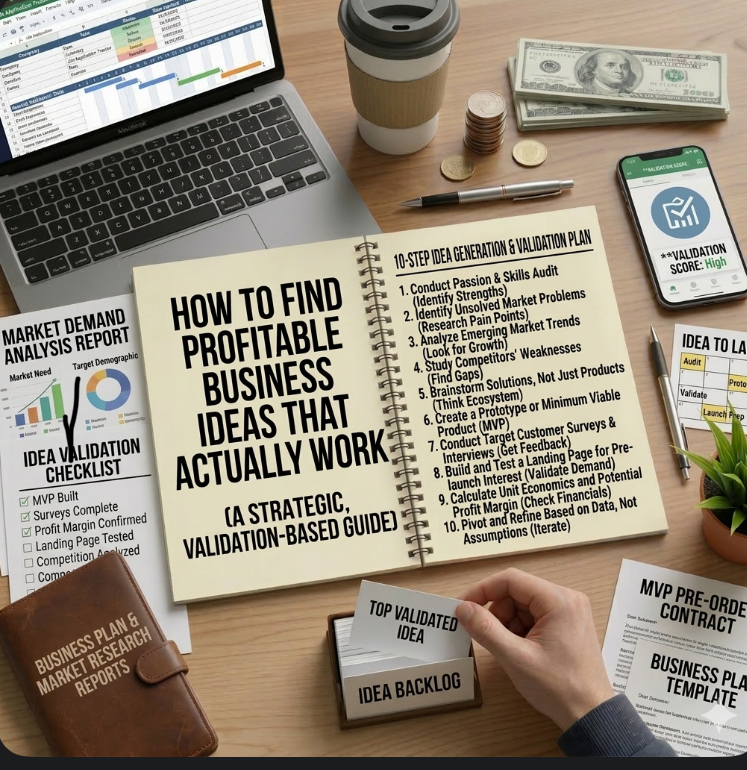
How to find profitable business idea that actually works
Great business ideas dont come from flashes of genius, they come from a deliberate process anyone can learn. Here’s how to find a profitable idea worth building.
One of the most common reasons people never start a business is that they can't settle on the right idea. They brainstorm endlessly, second-guess every option, wait for a flash of inspiration that never comes, and eventually conclude they're just "not creative enough" to be an entrepreneur.
Here's the truth: great business ideas are not born from flashes of genius. They're found through a deliberate, repeatable process of observation, research, and validation. And anyone can learn that process.
This guide will show you exactly how to find a profitable business idea that actually works — one that solves a real problem, has genuine demand, and suits your skills and lifestyle.
What Makes a Business Idea "Profitable"?
Before we look at how to find ideas, it's worth understanding what makes one worth pursuing. A profitable business idea has three core characteristics:
- It solves a real problem — people have a genuine pain point, frustration, or unmet need that your business addresses
- People will pay for the solution — the problem is painful or important enough that customers are willing to spend money to solve it
- You can deliver the solution — you have or can acquire the skills, resources, and access needed to actually build and run the business
An idea that ticks all three boxes is worth exploring. An idea that's missing any one of them will struggle regardless of how hard you work.
Method 1: Start With Your Own Problems
The most reliable source of profitable business ideas is your own life. The problems you personally experience are problems that thousands — sometimes millions — of other people experience too. And because you've lived the problem yourself, you understand it deeply and are well-positioned to build a genuinely useful solution.
Ask yourself:
- What frustrates me regularly that doesn't have a good solution?
- What do I wish existed but doesn't?
- What tasks in my life or work are unnecessarily difficult, time-consuming, or expensive?
- What have I had to figure out the hard way that others could benefit from?
Keep a running list of these friction points. Review it regularly. Some of the world's most successful companies — Airbnb, Dropbox, Slack — started because their founders were frustrated by problems they experienced personally and couldn't find a satisfying solution for.
Method 2: Look at What People Complain About
Other people's complaints are a goldmine of business ideas. When people complain, they're telling you exactly what problems they'd pay to have solved.
Where to find complaints:
- Reddit — subreddits in any niche are full of people expressing frustrations and asking for solutions. Search for phrases like "I wish there was" or "why doesn't anyone make" in relevant communities.
- Amazon reviews — particularly one and two-star reviews. These tell you exactly what existing products fail to deliver — which is an opportunity to do it better.
- App store reviews — same principle. Look at what users complain about in competing apps.
- Social media — Twitter, Facebook groups, LinkedIn comments. People are remarkably candid about their frustrations online.
- Forums and community groups — niche communities in any industry are full of people discussing unsolved problems.
The pattern you're looking for is the same complaint appearing repeatedly across multiple people. When many people share the same frustration, there's likely a viable business in solving it.
Method 3: Monetise a Skill You Already Have
The fastest path to a profitable business is often the one closest to where you already are. If you have a skill — professional, creative, technical, or practical — there's almost certainly a market of people who need that skill and are willing to pay for it.
Think about:
- What do people regularly ask you for help with?
- What are you significantly better at than most people around you?
- What knowledge or expertise have you built up through your career, education, or hobbies?
- What could you teach someone else to do?
Skills that can be turned into businesses include writing, design, coding, marketing, accounting, photography, cooking, fitness coaching, language teaching, legal knowledge, medical knowledge, carpentry, plumbing, and hundreds more. The business model could be freelancing, consulting, teaching, creating digital products, or building a service business around that skill.
Method 4: Look for Gaps in Existing Markets
You don't need to invent something entirely new to build a profitable business. Many successful businesses simply do an existing thing better — for a specific audience, at a better price, with better service, or with a feature that competitors have overlooked.
How to find gaps:
- Research existing products and services in a market you're interested in. What do customers consistently say is missing or inadequate?
- Look at successful businesses in other countries that haven't yet launched in your market.
- Identify underserved niches — specific customer groups whose needs aren't well met by existing solutions. A general product designed for everyone often serves no one particularly well.
- Look at industries that are slow to adopt new technology or customer expectations. Traditional, old-fashioned industries are often ripe for disruption.
Method 5: Follow Trends Early
Identifying trends early — before they become saturated — can give a new business a significant head start. Businesses that enter a growing market early benefit from lower competition, more attention, and the credibility of being established by the time others arrive.
Tools for spotting trends:
- Google Trends — shows search interest in any topic over time. Rising search volume signals growing demand.
- TikTok and Instagram — emerging trends often appear on social media before they hit mainstream markets.
- Product Hunt — new products launching daily, many of which point to emerging categories and consumer interests.
- Industry newsletters and reports — publications in any industry regularly highlight emerging trends and technologies.
- Exploding Topics — a tool specifically designed to surface rapidly growing trends before they peak.
The sweet spot is a trend that's growing but not yet crowded — early enough that there's still opportunity, established enough that demand is real.
How to Evaluate a Business Idea
Once you have a list of potential ideas, evaluate them against these criteria before committing significant time or money to any one:
- Is there clear demand? Are people already searching for, buying, or asking about solutions to this problem?
- Are people willing to pay? Is there evidence of existing spending in this space — competitors with paying customers, products already selling?
- Can you reach your customers? Do you have a clear, realistic path to finding and connecting with your target customers?
- Can you compete? If there are existing competitors, is there something you can do meaningfully better, differently, or for a specific audience they're not serving well?
- Does it suit your skills and lifestyle? The best business for you is one you can actually build and sustain — not just the most theoretically profitable one.
- Can you start small and validate? Can you test the idea quickly and cheaply before committing to it fully?
No idea will score perfectly on every criterion. But ideas that score well across most of them are worth testing.
The Most Important Step: Validate Before You Build
The single biggest mistake new entrepreneurs make is investing months of time and significant money into building a business before testing whether anyone actually wants what they're offering.
Validation means getting real evidence — ideally a paying customer or a clear expression of intent to pay — before you fully commit to an idea. Some ways to validate quickly and cheaply:
- Talk to 10–20 potential customers and ask about their problem — not your solution
- Create a simple landing page describing your offer and drive traffic to it to measure interest
- Pre-sell your product or service before it's fully built — if people will pay in advance, demand is real
- Offer a manual version of the service to a few customers before building any technology or infrastructure
Validation saves you from the most expensive mistake in entrepreneurship: building something nobody wants.
The Bottom Line
Finding a profitable business idea is not about waiting for lightning to strike. It's about looking in the right places, asking the right questions, and testing your assumptions before committing fully.
Start with the problems in your own life. Pay attention to what people complain about. Look at your existing skills with fresh eyes. Explore gaps in markets you know well. And when you find an idea that feels promising — validate it before you build it.
The right idea is closer than you think. You just need to start looking.
Do you have a business idea you're sitting on but haven't acted on yet? Share it in the comments — sometimes just putting it out there is the first step to making it real.
 Nathaniel_Adamu
Related Posts
 Business & Entrepreneurship
 Business & Entrepreneurship
0 Comments
No comments yet. Be the first to comment!
Leave a comment
Trending News



Newsletter
Stay updated with the latest personal finance and money tips.