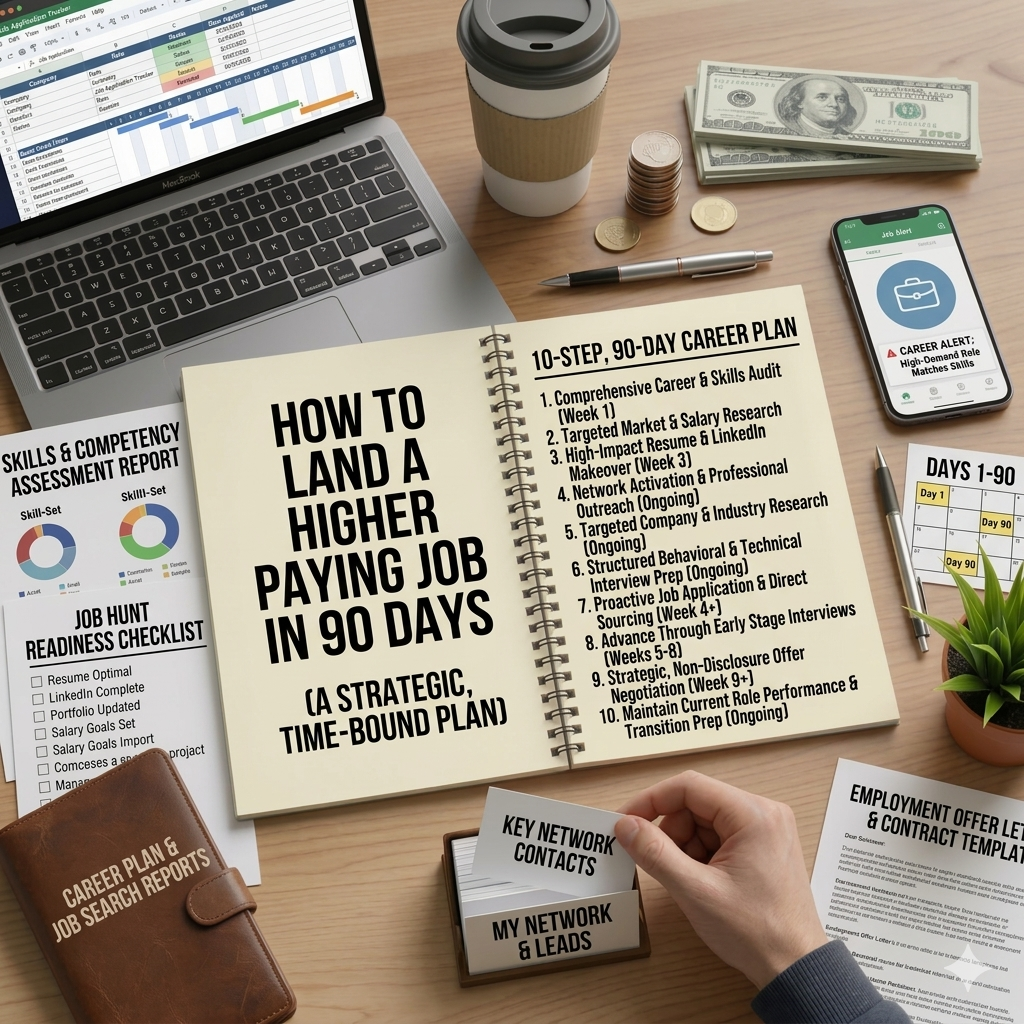
How To Land a Higher Paying Job in 90 Days
Landing a higher paying job isn’t a luck, it’s about strategy. Here’s a 90 day plan to position yourself, apply strategically and negotiate a salary you deserve.
Most people spend years waiting for a pay rise that may never come, instead of taking deliberate steps to dramatically increase their income within a few months. The truth is, landing a higher-paying job is not about luck or timing — it's about strategy. And with the right approach, 90 days is more than enough time to make it happen.
This guide will walk you through exactly what to do — week by week — to position yourself for a significantly better-paying role, whether that's within your current company or somewhere new.
Why 90 Days?
Ninety days is roughly three months — long enough to make meaningful progress on your skills, your network, and your job search, but short enough to maintain urgency and momentum. Most people who set a vague goal of "finding a better job someday" never do. A 90-day timeframe forces you to treat it like a project with a deadline.
The steps below are designed to be actionable from day one. You don't need to wait until you feel ready. You start now and build momentum as you go.
Month 1: Prepare and Position
Week 1 — Get Clear on What You Want
Before you apply for a single job, get clear on what "higher-paying" actually means for you. This isn't just about salary — it's about total compensation, role fit, growth potential, and lifestyle.
Answer these questions honestly:
- What is your current salary and what is your target salary?
- What roles are you qualified for that pay significantly more than your current role?
- Are you open to a different industry, company size, or location?
- What skills or experience gaps exist between where you are and the roles you want?
Research salary data on Glassdoor, LinkedIn Salary, and Payscale for your target roles. Know your market value before you start negotiating for it.
Week 2 — Update Your CV, LinkedIn, and Portfolio
Your CV and LinkedIn profile are your first impression — and most people's are significantly weaker than they should be. Invest time here. It pays dividends throughout the entire job search.
- CV: Tailor it to the roles you're targeting. Lead with achievements and quantifiable results, not just job descriptions. Use strong action verbs. Keep it clean, concise, and relevant.
- LinkedIn: Update your headline to reflect where you want to go, not just where you are. Write a compelling summary. Add recent achievements. Turn on "Open to Work" discreetly if needed.
- Portfolio or work samples: If relevant to your field, have two to three strong examples of your best work ready to share.
Week 3 — Identify Your Target Companies
Don't apply randomly. Build a target list of 20–30 companies where you'd genuinely want to work and that offer roles at your target salary level. Research each one — their culture, recent news, growth trajectory, and what roles they typically hire for.
Having a focused target list makes your job search more efficient and your applications more tailored — which significantly increases your response rate.
Week 4 — Close Your Skills Gaps
Look at the job descriptions for your target roles and identify any skills or qualifications that keep appearing that you don't currently have. Prioritise the ones that appear most frequently and that you could realistically develop in 60 days.
Free and low-cost resources for upskilling quickly include Coursera, LinkedIn Learning, Google's free certification programmes, YouTube, and industry-specific platforms. Even adding one relevant certification to your CV in 90 days can make a meaningful difference to how recruiters perceive you.
Month 2: Build Visibility and Apply Strategically
Week 5 — Activate Your Network
Research consistently shows that the majority of jobs — particularly higher-paying ones — are filled through referrals and networking rather than cold applications. Your network is your most powerful job search tool, and most people dramatically underuse it.
Reach out to former colleagues, managers, classmates, and professional contacts. Let them know you're exploring new opportunities. Ask for informational interviews — 20-minute conversations to learn about their company, role, or industry. These conversations often lead directly to job referrals or introductions.
Don't only reach out when you need something. Add value first — share an interesting article, congratulate someone on a career milestone, offer to help with something. Networking is a relationship, not a transaction.
Week 6 — Apply Strategically, Not Frantically
Quality beats quantity every time in job applications. Sending 50 generic applications produces fewer results than sending 10 highly tailored ones. For each application:
- Customise your CV to mirror the language and priorities in the job description
- Write a short, specific cover letter that addresses the company's needs directly
- Research the company thoroughly before any interview
- Follow up professionally one week after applying if you haven't heard back
Week 7 — Leverage LinkedIn Actively
LinkedIn is the world's largest professional network and a primary recruiting tool for hiring managers. Use it actively during your job search:
- Connect with recruiters and hiring managers at your target companies
- Engage with content in your industry — comment thoughtfully, share insights, post your own perspectives
- Use LinkedIn's job search filters to find roles that match your salary expectations
- Message recruiters directly — a brief, professional message expressing genuine interest in a specific role gets responses more often than people expect
Week 8 — Prepare for Interviews
Most people underprepare for interviews and then wonder why they don't get offers. Preparation is what separates candidates who get hired from those who don't.
- Research the company, its products, its competitors, and recent news thoroughly
- Prepare answers to common interview questions using the STAR method (Situation, Task, Action, Result)
- Prepare five to ten questions to ask the interviewer — thoughtful questions signal genuine interest and intelligence
- Practice out loud — with a friend, in front of a mirror, or recorded on your phone. Hearing yourself answer questions reveals weaknesses you can't spot on paper
Month 3: Interview, Negotiate, and Close
Week 9 and 10 — Interview With Confidence
By now you should have interviews booked. Go into each one prepared, confident, and focused on demonstrating the specific value you bring to that company's specific challenges.
Key interview principles:
- Listen carefully before answering — understanding the question fully before responding shows maturity and intelligence
- Lead with results and impact, not just responsibilities
- Be honest about what you don't know — but frame it as something you'd approach and learn
- Show enthusiasm for the specific role and company — generic enthusiasm is easy to spot and unconvincing
- Follow up with a brief thank-you message within 24 hours of every interview
Week 11 — Negotiate Your Salary
This is where most candidates leave significant money on the table. Never accept the first offer without negotiating — it's expected, and hiring managers almost always have room to move.
- Let the employer make the first offer if possible
- Counter with a specific number backed by your market research and the value you bring
- Negotiate the full package — base salary, bonus, equity, benefits, remote work flexibility, additional leave
- Be professional and collaborative in tone — you're negotiating a partnership, not winning a battle
- Get the final offer in writing before giving notice at your current job
Week 12 — Close and Transition
Once you have a written offer you're happy with, give appropriate notice at your current role, leave professionally and graciously, and prepare for a strong start in your new position. How you leave a job matters — the professional world is smaller than it seems, and your reputation follows you.
What If 90 Days Isn't Enough?
Not everyone will land a higher-paying role within exactly 90 days — and that's completely fine. The value of the 90-day framework is the structure and momentum it creates. Even if your job search takes four or five months, following this approach will produce significantly better results than a passive, unfocused search.
If you reach day 90 without an offer, review what's working and what isn't. Are you getting interviews but not offers? Your interview preparation needs work. Are you not getting interviews? Your CV or application strategy needs refinement. Treat it as data, adjust, and keep going.
The Bottom Line
A higher-paying job doesn't happen by waiting and hoping. It happens because you prepare deliberately, apply strategically, network actively, and negotiate confidently. Those are all learnable skills — and 90 days is enough time to put all of them into practice.
Your income is not fixed. It's negotiable. Start today.
Are you currently looking for a higher-paying role or thinking about making a move? Share where you are in the process in the comments — we'd love to help!
 Nathaniel_Adamu
Related Posts
 Business & Entrepreneurship
 Business & Entrepreneurship
0 Comments
No comments yet. Be the first to comment!
Leave a comment
Trending News




Newsletter
Stay updated with the latest personal finance and money tips.