
How to Start a Business With Little Money: A Step-by-Step Guide for First-Time Entrepreneurs
You don't need a big budget to start a business. Here's a practical, step-by-step guide to launching your first business from scratch — even if you're starting with almost nothing.
Starting a business sounds like something that requires a lot of money, a perfect idea, and years of experience. The reality? Some of the most successful businesses in the world started with very little capital — just a clear problem to solve, a willingness to learn, and the courage to begin.
You don't need a huge budget to start a business. You need a plan, the right mindset, and a step-by-step approach that keeps your costs low while you validate your idea. This guide will walk you through exactly how to start a small business from scratch — even if you're starting with next to nothing.
Step 1: Start With a Problem, Not a Product
The biggest mistake aspiring entrepreneurs make is falling in love with an idea before checking whether anyone actually needs it. Successful businesses don't start with products — they start with problems.
Ask yourself:
- What problem do I personally experience that isn't well solved?
- What do people around me complain about regularly?
- What would I pay money for if it existed?
- What skills or knowledge do I have that others would find valuable?
The clearer and more specific the problem you're solving, the easier everything else becomes — finding customers, marketing your offer, and explaining your value. A business that solves a real, felt problem will always have demand.
Step 2: Validate Before You Build
Before you invest time, money, or energy into building a full product or service, validate that people actually want what you're planning to offer. This is the step most first-time entrepreneurs skip — and it's why so many businesses fail early.
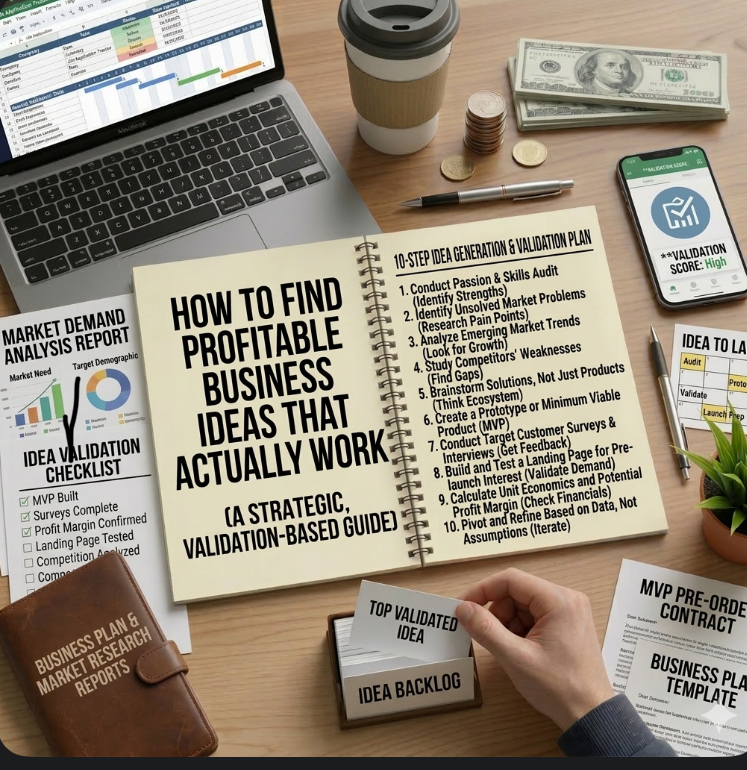
Validation doesn't have to be complicated. Some simple ways to test your idea:
- Talk to potential customers. Have honest conversations with 10–20 people who fit your target customer profile. Ask about their problems, not your solution. Listen more than you talk.
- Pre-sell your offer. If people will pay for something before it fully exists, that's the strongest possible validation. Offer a discounted early-bird price and see if anyone buys.
- Build a minimum viable product (MVP). Create the simplest possible version of your product or service and offer it to a small group of real customers. Their feedback is worth more than any amount of planning.
- Test with a landing page. Create a simple one-page website describing your offer and drive a small amount of traffic to it. Measure how many people sign up or express interest.
Validation saves you from spending months building something nobody wants. It's the most important step in the early stages of any business.
Step 3: Choose the Right Business Model
Your business model is how you make money. Different models suit different ideas, skills, and lifestyles. Common options for first-time entrepreneurs include:
- Service business — you sell your time and skills directly to clients (freelancing, consulting, coaching, agency work). Low startup cost, fast to revenue, but income is tied to your time.
- Product business — you create and sell a physical or digital product. Digital products (e-books, templates, courses, software) have no inventory cost and can scale without additional effort.
- Reselling / dropshipping — you sell products made by others without holding inventory. Lower margins but lower risk and lower startup cost.
- Content business — you build an audience through a blog, YouTube channel, podcast, or social media and monetise through advertising, affiliate marketing, sponsorships, or your own products.
- Subscription model — customers pay a recurring fee for ongoing access to a product, service, or community. Predictable income and strong long-term value.
For most people starting with little money, a service business is the fastest path to initial revenue. Once you have cash coming in, you can invest in building more scalable models.
Step 4: Write a Simple One-Page Business Plan
You don't need a 50-page business plan to start. What you do need is clarity — on what you're selling, who you're selling it to, how you'll reach them, and how the money works. A simple one-page plan covers:
- The problem you solve — one or two sentences
- Your target customer — who specifically you're selling to
- Your offer — what you sell and at what price
- Your revenue model — how you make money
- Your marketing strategy — how you'll find and reach customers
- Your startup costs — what you need to spend to get started
- Your break-even point — how many sales you need to cover your costs
Writing this down forces clarity and surfaces assumptions that need testing. Keep it simple. You can always expand it later.
Step 5: Keep Your Startup Costs as Low as Possible
One of the most common reasons new businesses fail is running out of money before they find product-market fit. The solution is to start lean — spend as little as possible until you've validated your idea and have revenue coming in.
Practical ways to keep costs low at the start:
- Use free tools wherever possible — Google Workspace, Canva, Notion, Trello, and many others are free for individuals and small teams
- Build your own simple website using platforms like WordPress, Wix, or Carrd instead of hiring a developer
- Start without an office — work from home or a local coffee shop or library
- Don't register a company or buy equipment until you have paying customers
- Do everything yourself first — only hire or outsource tasks that you genuinely can't do and that are essential
The goal is to get to your first sale as quickly and cheaply as possible. Revenue solves most early business problems.
Step 6: Get Your First Customer
Your first customer is the most important milestone in any business. Everything before it is theory. Once you have a paying customer, you have proof that your idea works.
How to get your first customer when you're starting from zero:
- Tell everyone you know. Your first customers are often people in your existing network. Post on social media, send messages to friends and former colleagues, and tell people what you're building and who it's for.
- Offer a discounted or free trial. Getting your first few customers sometimes means offering a deal to get testimonials and build social proof. This is an investment, not a loss.
- Join communities where your target customers hang out. Facebook groups, Reddit communities, LinkedIn groups, local business networks — participate, add value, and let people know you exist.
- Cold outreach. Identify specific people or businesses who could benefit from what you offer and reach out directly with a personalised, value-focused message.
- Partner with someone who already has your audience. Find a complementary business or individual and explore whether you can refer customers to each other.
Step 7: Deliver Exceptionally Well and Ask for Referrals
For a new business with a small marketing budget, word of mouth is your most powerful growth tool. The best way to generate word of mouth is to deliver results that exceed your customers' expectations — and then explicitly ask them to refer others.
Happy customers who refer others cost you nothing and convert at a much higher rate than cold leads. Build referral-asking into your process from the start. A simple "If you've enjoyed working with me, I'd really appreciate it if you could refer me to anyone who might benefit" goes a long way.
Also ask for testimonials and reviews early. Social proof is essential for attracting new customers, especially when you're just starting out.
Step 8: Track Your Money From Day One
Even the smallest business needs basic financial tracking. Know your revenue, your expenses, your profit, and your cash flow at all times. You don't need fancy accounting software to start — a simple spreadsheet works perfectly well.
Separate your business money from your personal money as soon as possible, even if it's just a separate bank account. This makes bookkeeping easier, keeps your finances clean, and is essential if you ever formalise the business or deal with taxes.
Common First-Time Entrepreneur Mistakes to Avoid
- Spending too much time planning and not enough time selling. A business exists when it has customers, not when it has a perfect plan.
- Trying to serve everyone. The more specific your target customer, the easier it is to find them, speak to them, and convert them.
- Underpricing your offer. Charging too little attracts difficult customers, creates unsustainable economics, and signals low value. Price based on the value you deliver, not your insecurity.
- Ignoring marketing. A great product nobody knows about is a hobby, not a business. Marketing is not optional.
- Giving up too early. Most businesses take longer to gain traction than founders expect. Persistence through the early slow period is what separates businesses that make it from those that don't.
The Bottom Line
Starting a business with little money is absolutely possible — but it requires clarity, discipline, and a bias toward action over perfection. The entrepreneurs who succeed aren't necessarily the ones with the best ideas or the most funding. They're the ones who start, learn fast, adapt, and keep going.
You don't need everything figured out before you begin. You need a real problem, a willing customer, and the courage to make your first offer.
Start small. Start now. Build from there.
Are you thinking about starting a business, or are you already in the early stages? Share where you are in the comments — we'd love to hear your story and help where we can.
 Nathaniel_Adamu
Related Posts
 Business & Entrepreneurship
 Business & Entrepreneurship
0 Comments
No comments yet. Be the first to comment!
Leave a comment
Trending News

Newsletter
Stay updated with the latest personal finance and money tips.