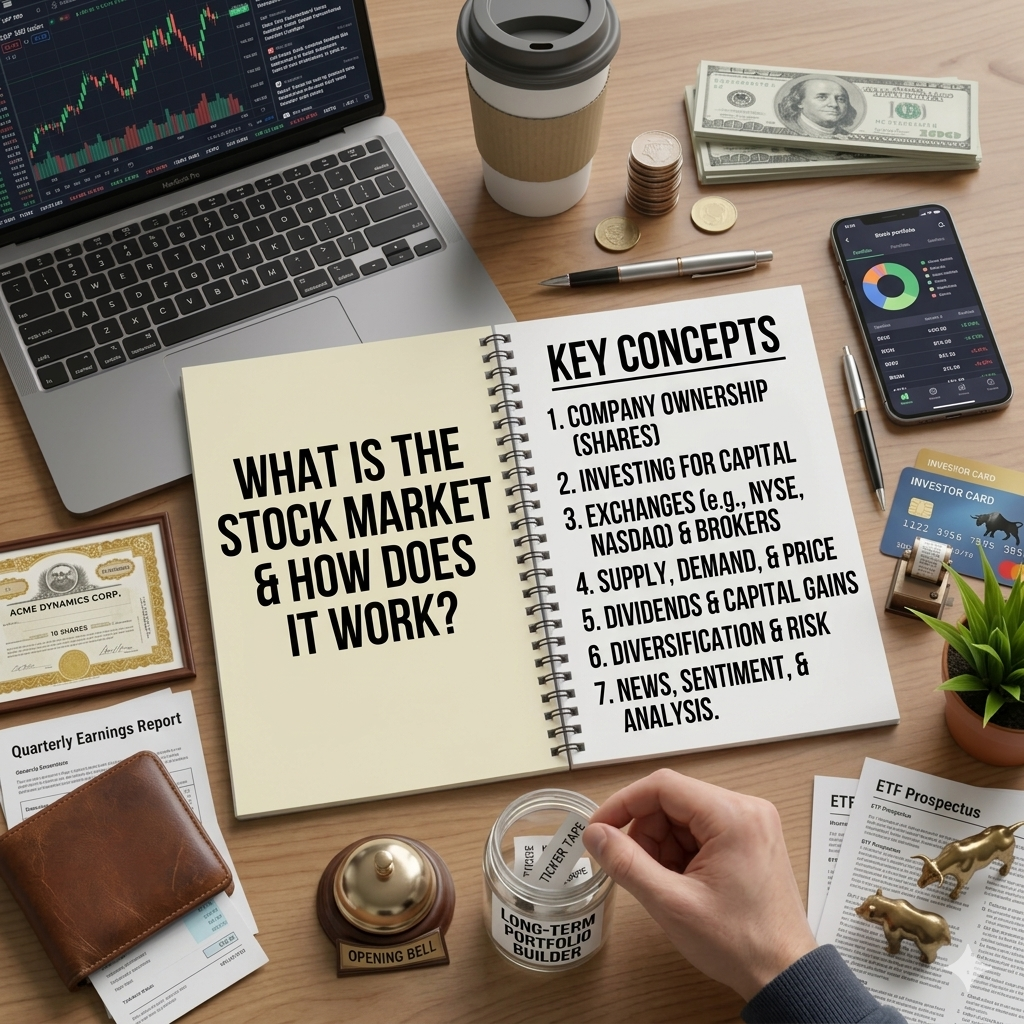
What Is The Stock Market And How Does It Work?
The stock market affects your life whether you invest or not. Here’s a plain language explanation of what it is, how it works and why it matters to ordinary people.
You've heard about the stock market your entire life. It's on the news, in conversations about the economy, and constantly referenced whenever someone talks about investing or building wealth. But if you've ever wondered what it actually is, how it works, and why it matters to ordinary people — you're not alone.
The stock market can seem intimidating and complicated from the outside. In reality, the core concept is surprisingly simple. This guide breaks it all down in plain language — no financial jargon, no prior knowledge required.
What Is the Stock Market?
The stock market is a marketplace where people buy and sell shares of publicly listed companies. Think of it like a giant, organised auction that runs every weekday — where instead of bidding on paintings or antiques, people are buying and selling small ownership stakes in businesses like Apple, Amazon, Toyota, or any other publicly traded company.
When a company wants to raise money to grow its business, one option is to sell shares to the public — this is called an Initial Public Offering, or IPO. Once those shares are available, anyone can buy and sell them on the stock market. The price of each share goes up or down based on how much buyers are willing to pay for it at any given moment.
The stock market is not one single place. It's a network of exchanges — the most well-known being the New York Stock Exchange (NYSE) and the NASDAQ in the United States, the London Stock Exchange (LSE) in the UK, and many others around the world. Today, almost all trading happens electronically.
What Is a Stock?
A stock — also called a share or equity — represents a small ownership stake in a company. If a company has issued one million shares and you own 1,000 of them, you own 0.1% of that company.
As a shareholder, you benefit in two main ways:
- Capital appreciation — if the company grows and becomes more valuable, the price of your shares increases. You can sell them later for more than you paid.
- Dividends — some companies distribute a portion of their profits to shareholders as regular cash payments called dividends. Not all companies pay dividends — many reinvest profits back into the business instead.
Of course, shares can also fall in value if the company performs poorly or if broader economic conditions deteriorate. This is the risk that comes with investing in stocks.
How Does the Stock Market Work?
At its most basic level, the stock market works on the principle of supply and demand. If more people want to buy a particular stock than sell it, the price goes up. If more people want to sell than buy, the price goes down.
Here's a simplified version of how a transaction works:
- You decide you want to buy 10 shares of a company. You place an order through your broker or investing app.
- Your order is sent to the stock exchange, where it's matched with a seller who wants to sell at your price.
- The transaction is completed — you now own 10 shares, and the seller has received your payment.
- The price of that share is updated to reflect the price at which the last transaction occurred.
This process happens millions of times every day across stock markets worldwide, with prices updating in real time.
What Moves Stock Prices?
Stock prices change constantly during trading hours. Many factors influence whether a stock goes up or down:
- Company performance — strong earnings reports, new products, or expanding profits push prices up. Poor results or missed expectations push prices down.
- Economic conditions — interest rates, inflation, employment data, and GDP growth all affect investor confidence and stock prices broadly.
- News and events — a major product launch, a scandal, a merger, a regulatory change, or even a tweet from a prominent figure can move a stock price significantly.
- Investor sentiment — sometimes prices move based on how investors feel about the future, not just current reality. Fear and greed are powerful forces in financial markets.
- Supply and demand — ultimately, a stock is worth whatever someone is willing to pay for it at any given moment.
What Are Stock Market Indices?
You've probably heard references to "the S&P 500 is up today" or "the FTSE 100 fell." These are stock market indices — benchmarks that track the performance of a group of stocks to give a general picture of how the market is doing.
Some of the most important indices globally:
- S&P 500 — tracks the 500 largest publicly traded companies in the United States. It's the most widely followed benchmark for the US stock market.
- Dow Jones Industrial Average (DJIA) — tracks 30 large, well-established US companies. One of the oldest and most recognised indices in the world.
- NASDAQ Composite — heavily weighted toward technology companies. Home to companies like Apple, Google, Meta, and Amazon.
- FTSE 100 — tracks the 100 largest companies listed on the London Stock Exchange.
- Nikkei 225 — tracks 225 large companies on the Tokyo Stock Exchange in Japan.
When people say "the market is up" or "the market crashed," they're usually referring to one of these indices.
Who Participates in the Stock Market?
The stock market isn't just for Wall Street professionals. Participants include:
- Individual retail investors — ordinary people like you and me, investing through brokerage accounts or apps
- Institutional investors — pension funds, insurance companies, mutual funds, and hedge funds that manage large pools of money on behalf of clients
- Companies — businesses that buy back their own shares or invest in other companies
- Market makers — firms that ensure there's always a buyer and seller available, maintaining liquidity in the market
- Governments and central banks — which influence markets through monetary policy decisions
Why Does the Stock Market Matter to Ordinary People?
Even if you've never bought a single share, the stock market affects your life in more ways than you might realise:
- Pensions and retirement funds — if you have a pension or retirement account, it's almost certainly invested in the stock market. When markets rise, your retirement savings grow.
- Economic health — a rising stock market generally reflects business confidence and economic growth, which affects employment, wages, and the broader economy.
- Wealth building — for individuals who invest, the stock market is one of the most powerful long-term wealth-building tools available. Historically, a diversified investment in the stock market has grown significantly over time.
- Inflation protection — investing in stocks has historically outpaced inflation over the long term, preserving and growing the purchasing power of your money.
Is the Stock Market Risky?
Yes — and it's important to be honest about that. Stock prices can and do fall, sometimes dramatically. Market crashes happen periodically — and during a crash, portfolios can lose 20%, 30%, or even 50% of their value in a short period.
However, context matters enormously:
- Every major market crash in history has eventually been followed by a recovery and new highs
- The longer your investment time horizon, the less short-term volatility matters
- Diversification — spreading investments across many companies and sectors — significantly reduces the impact of any single company performing badly
- Investing consistently over time, regardless of market conditions, reduces the risk of investing at exactly the wrong moment
Risk in the stock market is real but manageable — especially for long-term investors who stay diversified and don't panic during downturns.
How Can You Start Investing in the Stock Market?
Getting started is simpler than most people think:
- Open a brokerage account — choose a reputable, low-cost platform that suits your country and budget. Many offer commission-free trading and no minimum deposit.
- Start with index funds or ETFs — rather than picking individual stocks, buy a fund that tracks a broad market index like the S&P 500. Instant diversification, low fees, and historically strong long-term returns.
- Invest regularly — set up a monthly contribution, even a small one. Consistency over time is more important than the amount you start with.
- Think long term — the stock market rewards patience. The longer you stay invested, the more time compound growth has to work in your favour.
- Don't panic during downturns — market drops are normal and temporary. Selling during a crash locks in losses. Staying the course is almost always the right decision for long-term investors.
The Bottom Line
The stock market is not a casino for the wealthy or a mystery reserved for financial experts. It's a marketplace where ownership of businesses is bought and sold — and one of the most powerful tools available to ordinary people who want to build long-term wealth.
Understanding how it works is the first step. The second step is starting — even with a small amount — and letting time and compounding do the heavy lifting.
The best investors in history didn't get rich by timing the market perfectly. They got rich by staying in the market consistently, for a long time.
Did this help demystify the stock market for you? What questions do you still have? Drop them in the comments — no question is too basic, and we're happy to help.
 Nathaniel_Adamu
 Smart Investing
0 Comments
No comments yet. Be the first to comment!
Leave a comment
Trending News




Newsletter
Stay updated with the latest personal finance and money tips.