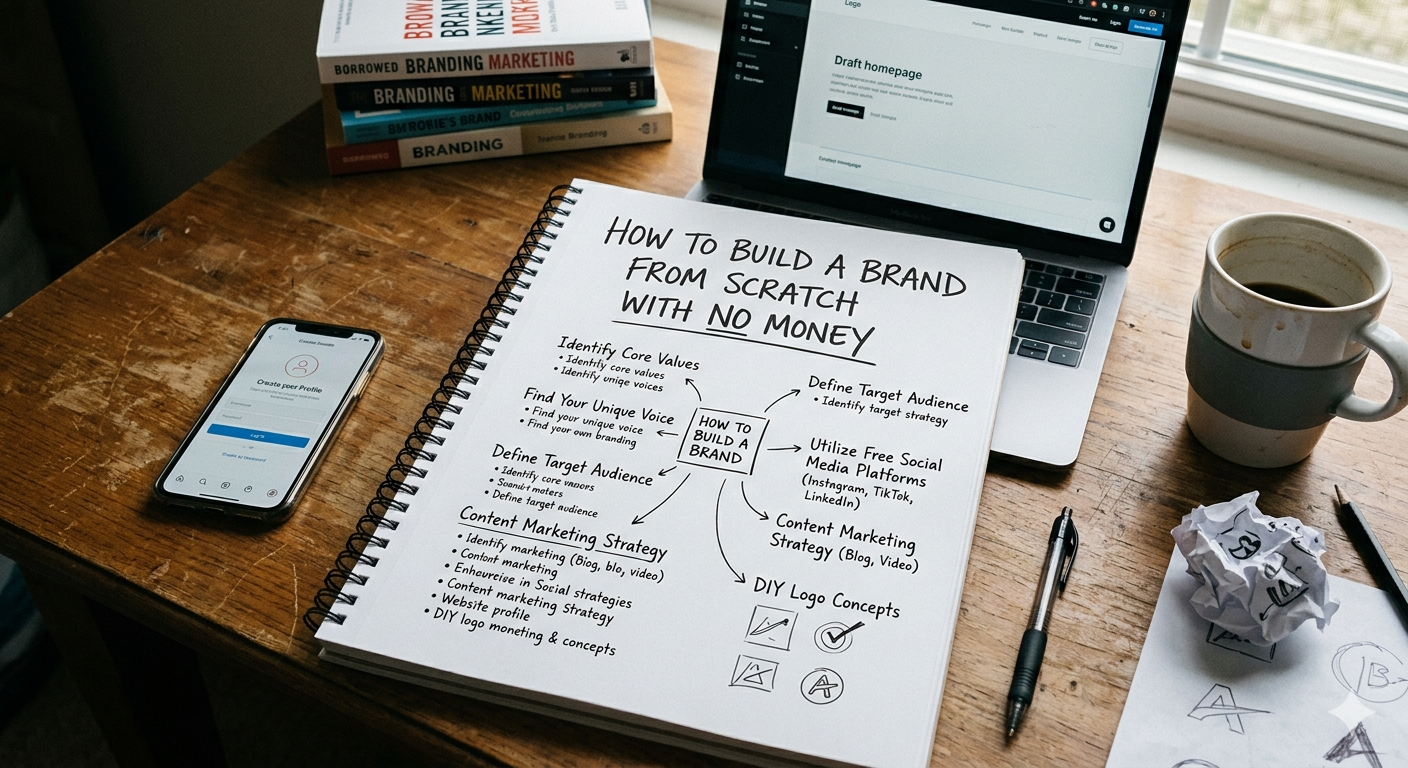
How to Build a Brand From Scratch With No Money
You don't need a big budget to build a strong brand. Here's a step-by-step guide to creating a recognisable, trusted brand from scratch — using nothing but clarity, consistency, and free tools.
When most people hear the word "brand," they think of big budgets, professional designers, and expensive marketing agencies. The reality is that some of the most recognisable and trusted brands in the world were built with very little money — just a clear identity, a consistent message, and the discipline to show up repeatedly over time.
Building a brand from scratch with no money is not only possible — it's how most successful personal brands and small businesses start. This guide will show you exactly how to do it, step by step.
What Is a Brand — Really?
Before diving into tactics, it's worth getting clear on what a brand actually is. A brand is not your logo. It's not your colour palette or your font choices. Those are brand assets — visual elements that represent your brand. Your brand itself is something deeper.
Your brand is the perception people have of you or your business. It's the feeling they get when they encounter your content, use your product, or interact with your service. It's the answer to the question: "What do people say about you when you're not in the room?"
A strong brand is built on three foundations: clarity (knowing exactly who you are and what you stand for), consistency (showing up the same way every time across every platform), and credibility (delivering on your promises repeatedly until trust is established).
Everything that follows is built on these three foundations.
Step 1: Define Your Brand Identity
You cannot build a brand without first knowing what that brand stands for. Before you design anything, post anything, or tell anyone about your business, answer these questions clearly and honestly:
- What do you do? Not just functionally — but what problem do you solve, and for whom?
- Who is your target audience? Be specific. "Everyone" is not a target audience. The more precisely you define who you serve, the more clearly you can speak to them.
- What makes you different? Why should someone choose you over alternatives? What do you offer that others don't — or don't do as well?
- What are your core values? What principles guide how you work and how you treat people?
- What is your brand personality? If your brand were a person, how would they speak? Formal or casual? Serious or humorous? Bold or understated? Warm or direct?
- What is your brand promise? What can people always expect from you, every single time?
Write the answers down. This document becomes your brand compass — the reference point for every decision you make about how you present yourself and your business.
Step 2: Choose Your Brand Name
If you're building a personal brand, your name is your brand. Simple, memorable, and already yours.
If you're building a business brand, choose a name that is:
- Easy to spell and pronounce — if people can't remember how to spell it, they can't find you
- Memorable — short, distinct names stick better than long descriptive ones
- Available — check that the domain name and social media handles are available before committing
- Relevant without being limiting — a name too tied to a specific product or location can become a constraint as you grow
Don't spend months agonising over a name. A good name executed consistently will always outperform a perfect name that never launches.
Step 3: Create Your Visual Identity for Free
You don't need to hire a designer to create a professional visual identity. Free tools have made this accessible to anyone.
- Canva — the most accessible design tool available. Use it to create a logo, choose brand colours, select fonts, and design all your visual assets. Canva's free plan is generous and sufficient for most early-stage brand needs.
- Looka or Hatchful — free AI-powered logo generators that produce professional-looking logos in minutes based on your brand inputs.
- Google Fonts — a library of free, professional fonts. Choose one or two that match your brand personality and use them consistently everywhere.
- Coolors — a free colour palette generator. Choose two or three brand colours and use them consistently across all your assets.
The goal at this stage is not perfection — it's consistency. Choose a simple visual style and apply it consistently everywhere you show up. Consistency over time builds recognition, and recognition builds trust.
Step 4: Establish Your Online Presence
In 2025, your brand needs to exist online — even if you primarily serve local customers. The good news is that establishing a basic online presence costs nothing.
Choose Your Primary Platform
You don't need to be everywhere at once. Choose one or two platforms where your target audience is most active and focus your energy there. Common options:
- Instagram — visual businesses, lifestyle, fashion, food, fitness, creative services
- LinkedIn — professional services, B2B businesses, career-focused personal brands
- TikTok — younger audiences, high organic reach, entertainment and education
- YouTube — long-form educational content, high trust-building potential
- Twitter/X — thought leadership, commentary, tech and finance audiences
- Facebook — local businesses, community groups, older demographics
Create a Simple Website
A website gives your brand a permanent, professional home that you own — unlike social media platforms that can change their algorithms or shut down. Free website builders like WordPress.com, Wix, and Google Sites let you create a basic professional website at no cost. At minimum, your website should include a clear description of what you do, who you serve, how to contact you, and social proof (testimonials, portfolio, or examples of your work).
Claim Your Social Media Handles
Even if you're not yet active on every platform, claim your brand name as a handle on the major ones. This prevents others from using your name and gives you the option to expand later.
Step 5: Create Content That Builds Trust
Content is the most powerful free brand-building tool available. When you consistently share valuable, relevant content for your target audience, you build awareness, demonstrate expertise, and develop trust — all without spending a penny on advertising.
Effective content for brand building:
- Educational content — teach your audience something useful related to your niche. This positions you as a knowledgeable, generous expert.
- Behind-the-scenes content — show the process, the work, the real person or team behind the brand. This builds authenticity and connection.
- Social proof — share testimonials, case studies, results, and reviews. Let other people's words build credibility for you.
- Personal stories — share relevant experiences, lessons learned, and your journey. People connect with people, not corporations.
- Opinions and perspectives — take clear, considered positions on topics relevant to your audience. Brands that stand for something attract loyal audiences; brands that try to appeal to everyone attract none.
Consistency matters more than perfection here. Posting valuable content three times per week, every week, for six months will build more brand equity than posting sporadically whenever inspiration strikes.
Step 6: Build Your Network and Community
Brands don't grow in isolation. The fastest way to build brand awareness with no money is through genuine relationships — with potential customers, with peers in your industry, and with people who already have the audience you want to reach.
- Engage authentically on social media — comment thoughtfully on other people's content, join conversations, respond to everyone who engages with yours
- Collaborate with complementary brands — joint content, cross-promotions, and partnerships expose you to new audiences at zero cost
- Get into communities where your target audience gathers — Facebook groups, Reddit communities, LinkedIn groups, industry forums — and add value before promoting yourself
- Ask for testimonials from early customers or clients and share them prominently
Step 7: Be Consistent and Patient
This is the step most people struggle with — and the one that separates brands that succeed from those that don't. Building a brand takes time. The results are rarely visible in the first month or even the first three months. But done consistently over 12–24 months, even a zero-budget brand built on clarity, consistency, and genuine value can develop real recognition and trust.
Most people give up too early. They post for a few weeks, see modest results, and conclude that "it doesn't work." The brands that break through are the ones that keep showing up — refining as they go, learning what resonates, and trusting that consistency compounds over time.
The Bottom Line
Building a brand with no money is entirely possible — but it requires something more valuable than money: clarity, consistency, and patience. Know exactly who you are and who you serve. Show up consistently with content that adds genuine value. Build real relationships. And keep going when it feels slow.
The brands that win are rarely the ones with the biggest budgets. They're the ones with the clearest identity and the most consistent presence.
Your brand starts with a decision to begin. Make that decision today.
Are you in the process of building a brand or thinking about starting one? Share where you are in the comments — we'd love to hear what you're building and offer any help we can!
 Nathaniel_Adamu
Related Posts
 Business & Entrepreneurship
 Business & Entrepreneurship
 Business & Entrepreneurship
0 Comments
No comments yet. Be the first to comment!
Leave a comment
Follow Us
Trending News

Newsletter
Stay updated with the latest personal finance and money tips.