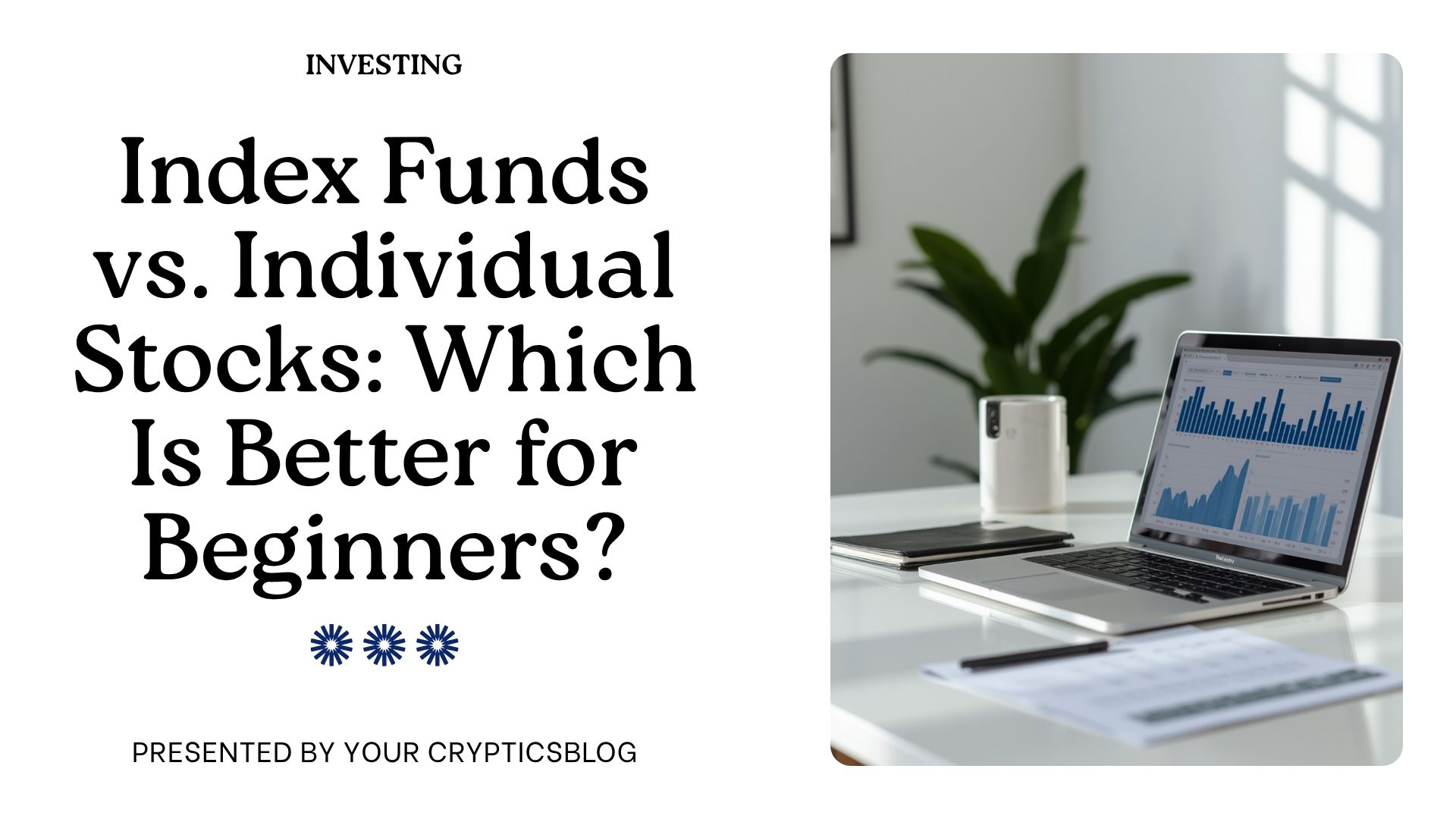
Index Funds vs Individual Stocks: Which Is Better for Beginners?
Index funds or individual stocks — which should a beginner invest in? Here's an honest, data-backed breakdown of both approaches to help you make the right decision for your situation.
When most people think about investing in the stock market, they imagine picking individual stocks — buying shares in companies they believe in and watching their investment grow. It's an exciting idea. But is it actually the best strategy for most investors, especially beginners?
The alternative — index funds — is far less glamorous but has a compelling track record. In this post, we break down the key differences between index funds and individual stocks, the pros and cons of each, and which approach makes more sense for where you are in your investing journey.
What Are Index Funds?
An index fund is a type of investment fund designed to replicate the performance of a specific market index — such as the S&P 500, which tracks the 500 largest publicly traded companies in the United States, or a global index that tracks thousands of companies worldwide.
Instead of a fund manager hand-picking investments, an index fund simply holds all — or a representative sample — of the stocks in its target index. If the S&P 500 rises 10%, an S&P 500 index fund rises approximately 10%. If it falls 8%, the fund falls approximately 8%.
Index funds are a form of passive investing — they don't try to beat the market, they try to match it. This passive approach comes with significantly lower costs than actively managed funds, which is one of the main reasons index funds have become so popular among long-term investors.
What Are Individual Stocks?
When you buy an individual stock, you're buying a direct ownership stake in a single company. If you buy shares in Apple, Tesla, or any other publicly listed company, you own a small piece of that business — and your investment rises or falls based on how that specific company performs.
Individual stock picking is the approach most people associate with investing — researching companies, analysing financials, and making calculated bets on which businesses will grow in value. It's the approach of legendary investors like Warren Buffett and Peter Lynch, and the one that makes for exciting financial news stories.
But as we'll see, the reality for most individual investors is considerably less exciting.
The Core Differences
Diversification
This is the most fundamental difference between the two approaches. When you invest in an S&P 500 index fund, you're instantly diversified across 500 companies in multiple sectors and industries. If one company collapses entirely, it has minimal impact on your overall portfolio — because it represents a tiny fraction of the fund.
When you buy individual stocks, your portfolio is only as diversified as the number of different companies you own. Owning shares in five technology companies is not meaningful diversification — they're all exposed to the same sector risks. True diversification through individual stocks requires owning shares in dozens of different companies across different sectors and geographies — which requires significant capital and research time.
Cost
Index funds are among the cheapest investment vehicles available. Many index funds charge an expense ratio — an annual fee as a percentage of your investment — of just 0.03% to 0.20%. On a $10,000 investment, that's $3 to $20 per year in fees.
Individual stock investing through modern commission-free brokers costs nothing per trade — but the hidden costs are your time researching companies, the risk of making uninformed decisions, and the opportunity cost of underperforming the broader market.
Performance
This is where the data becomes compelling — and humbling for stock pickers. Study after study has shown that the vast majority of actively managed funds — run by professional analysts and fund managers with access to research and data most individuals will never have — fail to consistently beat the market over the long term. Most underperform a simple S&P 500 index fund after fees.
If professional investors with teams of analysts and sophisticated tools can't reliably beat the market, the odds for individual retail investors doing so consistently are even lower. This is not to say it's impossible — some individual investors do beat the market — but it's far harder and rarer than most people assume.
Time and Effort
Investing in index funds requires very little ongoing effort. You buy, you hold, you add to your position regularly. You don't need to monitor quarterly earnings reports, track management changes, or analyse balance sheets. A total time investment of a few hours per year is sufficient.
Picking individual stocks well requires significant ongoing research. Understanding a company's business model, competitive position, financial health, management quality, and industry dynamics takes real time and expertise. For most people who have jobs, families, and other commitments, this time simply isn't available.
Risk
Individual stocks carry significantly more risk than index funds for a simple reason: a single company can fail entirely. Enron, Lehman Brothers, Wirecard — large, well-known companies that went to zero, wiping out investors who held concentrated positions in them. A diversified index fund eliminates this single-company failure risk almost entirely.
Index funds still carry market risk — when the broader market falls, so does your index fund. But the risk of permanent, total loss of your investment is dramatically lower.
The Case for Index Funds
- Instant diversification across hundreds or thousands of companies with a single purchase
- Low costs that compound significantly in your favour over decades
- Proven long-term performance that beats most active strategies after fees
- Minimal time required — buy, hold, and add regularly
- Reduced emotional decision-making — no temptation to sell when a single holding drops sharply
- Ideal for beginners who don't yet have the knowledge to evaluate individual companies
The Case for Individual Stocks
- Higher upside potential — a single stock can significantly outperform the market. Early investors in Amazon, Apple, or Tesla generated returns that no index fund could match.
- Control and ownership — you choose exactly which companies you own and can align your investments with your values
- Intellectual engagement — researching companies and following their progress is genuinely interesting for many investors
- No cap on returns — index funds are designed to match the market, not beat it. Individual stock picking, done well, can produce market-beating returns.
The Honest Verdict for Beginners
For the vast majority of beginner investors — and indeed most experienced ones — index funds are the better starting point. The evidence is clear, consistent, and overwhelming: low-cost index funds outperform most individual stock portfolios over the long term, with significantly less risk, less effort, and lower stress.
This doesn't mean individual stocks have no place in a portfolio. Many experienced investors hold a core of index funds alongside a smaller allocation to individual stocks they've researched thoroughly. A common approach is the so-called "core and satellite" strategy — 80–90% in diversified index funds (the core) and 10–20% in individual stocks or more speculative investments (the satellite).
But if you're just starting out, the single best thing you can do is open an account, buy a low-cost index fund tracking a broad market like the S&P 500 or a global index, and invest consistently over time. Master the fundamentals of investing first. Add individual stocks later, as your knowledge and confidence grow.
Which Index Funds Should a Beginner Consider?
Some of the most widely recommended index funds for beginners include:
- Vanguard S&P 500 ETF (VOO) — tracks the S&P 500, expense ratio of just 0.03%
- iShares Core S&P 500 ETF (IVV) — another excellent S&P 500 tracker with very low fees
- Vanguard Total World Stock ETF (VT) — tracks the global stock market across developed and emerging markets
- Fidelity ZERO Total Market Index Fund (FZROX) — zero expense ratio, tracks the entire US stock market
For investors outside the US, look for equivalent low-cost index funds or ETFs available through your local broker that track broad global or regional indices.
The Bottom Line
Index funds and individual stocks are not mutually exclusive — many investors use both. But for beginners, index funds offer the best combination of simplicity, diversification, low cost, and proven long-term performance.
Start with index funds. Learn as you go. And if individual stock picking interests you, approach it with proper research, realistic expectations, and money you can afford to be patient with.
The goal of investing is to build wealth over time — not to get rich quickly. Index funds are one of the most reliable tools ever created for doing exactly that.
Are you currently investing in index funds, individual stocks, or both? Share your experience and strategy in the comments — we'd love to hear what's working for you!
 Nathaniel_Adamu
Related Posts
 Smart Investing
 Smart Investing
0 Comments
No comments yet. Be the first to comment!
Leave a comment
Follow Us
Trending News



Newsletter
Stay updated with the latest personal finance and money tips.