
How to Turn Your Skill Into Income: A Beginner's Guide to Monetising What You Know
Most people are sitting on income they don't realise they have. Here's exactly how to identify your most valuable skills and turn them into a real, sustainable income stream.
Most people are sitting on income they don't realise they have. The skill you use every day at work, the hobby you've spent years developing, the knowledge you've accumulated through experience — all of it has potential value to someone else. The question is not whether you have a monetisable skill. It's whether you know how to turn it into income.
This guide will show you exactly how to identify your most valuable skills, match them to the right income model, and take the first practical steps toward getting paid for what you already know.
Why Most People Undervalue Their Skills
There's a well-documented psychological phenomenon called the curse of knowledge — the tendency to assume that what you know is common knowledge, simply because it feels obvious to you. The reality is that your expertise, however natural it feels, represents real value to people who don't have it.
A teacher who finds explaining complex topics easy doesn't realise how rare that ability is. A graphic designer who knocks out a logo in two hours doesn't register that most people couldn't produce anything close in two days. A person who has navigated a complex process — immigration, tax filing, business registration — doesn't recognise that others would pay to skip the learning curve they went through.
The first step to monetising your skills is recognising that what feels ordinary to you is genuinely valuable to others.
Step 1: Identify Your Most Monetisable Skills
Not all skills are equally monetisable — but more are than most people realise. To identify yours, work through these questions:
- What do people regularly ask you for help with? When friends, family, or colleagues come to you for advice or assistance, what is it usually about? These unsolicited requests are strong signals of where your expertise is genuinely valued.
- What can you do significantly better or faster than most people around you? Relative skill matters more than absolute skill. You don't need to be the world's best — you need to be meaningfully better than the people who would pay for your help.
- What have you spent significant time learning or doing? Years of experience in any field — even as a hobby — builds expertise that has value. Think about skills built through your career, education, and personal interests.
- What problems have you solved that others struggle with? Having navigated a difficult process or overcome a significant challenge gives you knowledge that others would pay to shortcut.
- What could you teach someone else to do? If you can explain how to do something clearly enough to teach it, you can monetise it through teaching, content, or consulting.
Write down everything that comes to mind without filtering. You can evaluate the options afterwards — the first step is generating a complete list.
Step 2: Match Your Skill to the Right Income Model
The same skill can be monetised in multiple different ways — each with different income potential, time requirements, and scalability. Understanding your options helps you choose the model that best fits your goals and lifestyle.
Freelancing and Consulting
The most direct path from skill to income. You offer your expertise as a service to clients who pay for your time or output. Suitable for almost any professional, creative, or technical skill — writing, design, coding, marketing, accounting, legal advice, coaching, and more.
Income potential: Immediate but capped by your time. Best for generating fast income from existing skills.
Teaching and Tutoring
If you can explain your skill clearly, you can teach it. One-on-one tutoring, group workshops, corporate training, and online courses all fall into this category. Teaching is one of the highest-value applications of expertise because people pay a premium to learn efficiently from someone who has already done what they're trying to do.
Income potential: High. One-on-one tutoring is immediate; online courses can become passive income once created.
Creating and Selling Digital Products
Packaging your knowledge into a product — an e-book, a guide, a template, a course, a toolkit — that can be sold repeatedly without additional time investment. This is the most scalable model for monetising knowledge, because you create it once and sell it indefinitely.
Income potential: Passive income with significant upside. Takes longer to generate initial income but scales well.
Content Creation
Building an audience through a blog, YouTube channel, podcast, or social media by sharing your expertise publicly. Once an audience is established, income comes through advertising, sponsorships, affiliate marketing, and your own products or services.
Income potential: Highest long-term upside but slowest to generate income. Typically 12–24 months before meaningful revenue.
Coaching and Mentoring
Helping individuals achieve specific outcomes using your expertise — career coaching, business coaching, fitness coaching, financial coaching, and more. Coaching commands premium rates because clients are paying for personalised attention and accountability, not just information.
Income potential: High rates, typically $50–$500+ per hour for experienced coaches in premium niches.
Licensing Your Knowledge
Creating frameworks, methodologies, or systems that others pay to use or implement. More advanced, but highly scalable once established — your intellectual property generates income without requiring your time.
Income potential: Highly scalable but requires an established reputation and significant upfront work.
Step 3: Define Your Target Audience
Before you can monetise a skill, you need to know who specifically would pay for it. The more precisely you define your audience, the more effectively you can reach them and the more you can charge — because specialised expertise for a specific audience is worth more than generic knowledge for everyone.
Define your target audience by asking:
- Who most needs the outcome my skill delivers?
- Who has the money and willingness to pay for it?
- What specific problem does my skill solve for them?
- Where do these people spend their time online and offline?
For example, rather than "I'll teach coding to anyone," a more monetisable positioning might be "I help marketing professionals learn enough Python to automate their reporting and save hours every week." Specific, valuable, and clearly targeted.
Step 4: Package and Price Your Offering
How you package and price your skill significantly affects how much you earn and how easy it is to sell.
Packaging
People don't buy skills — they buy outcomes. Package your offering around the result the client will achieve, not the process you'll use to deliver it. "I'll help you land your first freelance client within 30 days" is more compelling than "I'll teach you about freelancing."
Pricing
Most beginners underprice their skills dramatically. A few pricing principles:
- Price based on value delivered, not time spent. If your skill saves a client $10,000, charging $500 for it is not overpricing — it's a bargain for them.
- Research what the market charges. Look at what others with similar skills and experience charge on freelance platforms, coaching directories, and course marketplaces.
- Start slightly below market rate if you have no track record — but not so far below that you attract difficult clients or appear untrustworthy.
- Raise your prices as you accumulate testimonials and results. Your first five clients are not your forever clients — they're proof-of-concept at a discounted rate.
Step 5: Get Your First Paying Customer
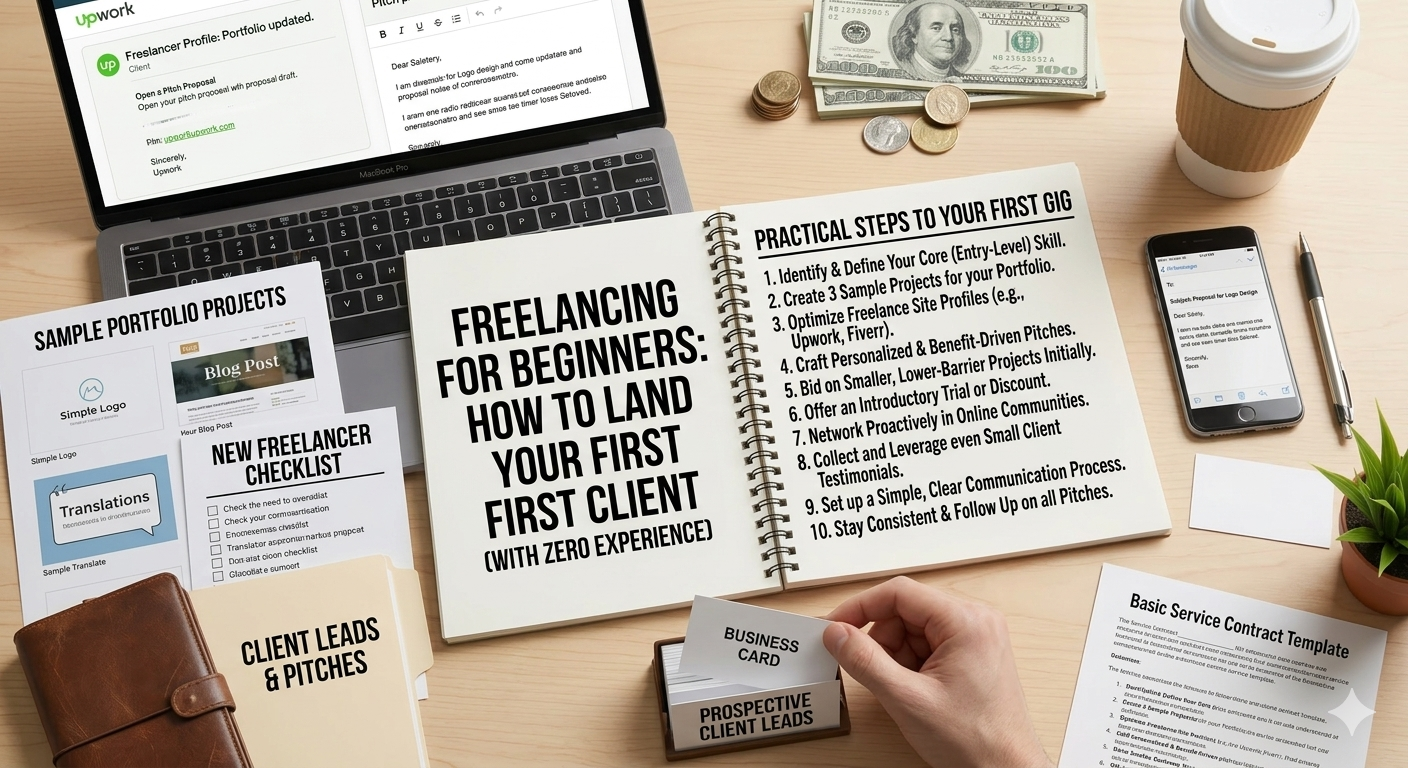
Everything before this step is preparation. Your first paying customer is what turns your skill into a business. Here's how to find them:
- Tell everyone you know. Your network is your fastest route to early clients. Post on social media, message former colleagues, tell friends and family what you're offering and who it's for.
- Go where your audience already is. Facebook groups, LinkedIn communities, Reddit forums, industry events — wherever your target clients gather, show up and add value before promoting yourself.
- Offer a discounted pilot. Offer your first two or three clients a reduced rate in exchange for a detailed testimonial. Real social proof is worth far more than the discount you give.
- Cold outreach done well. Identify specific people or businesses who need your skill and reach out with a personalised, value-focused message. Not "I'm a designer looking for work" — but "I noticed your website's checkout page has three friction points that are likely costing you conversions. I fix exactly this for e-commerce businesses. Can I show you what I'd do?"
Step 6: Deliver Exceptional Results and Build From There
Your first client is the foundation of everything that follows. Deliver work that genuinely exceeds their expectations. Communicate proactively. Meet every deadline. Go slightly beyond what was agreed.
Then ask for two things: a detailed testimonial and a referral. Word of mouth from a satisfied client is the most powerful and cost-effective marketing tool available to anyone starting out.
From your first client, build to your fifth. From five, build to twenty. Each client builds your reputation, your confidence, your portfolio, and your ability to charge more for the next one.
Skills That Are Particularly Easy to Monetise Right Now
While almost any skill can be monetised with the right approach, some are in particularly high demand in 2025:
- AI and automation skills — helping businesses implement and use AI tools effectively
- Content creation and copywriting — demand for quality written content remains consistently high
- Web development and design — every business needs a digital presence
- Video editing and production — video content continues to dominate online
- Data analysis — businesses are drowning in data and need people who can make sense of it
- Financial coaching and literacy — growing demand globally as people seek help managing money
- Language teaching — English in particular remains in extremely high demand globally
- Digital marketing — every business needs customers, and most struggle to find them online
The Bottom Line
You already have something valuable. The question is whether you're willing to package it, put it in front of the right people, and ask to be paid for it.
Monetising a skill is not about becoming the world's foremost expert. It's about being genuinely useful to a specific group of people — and building the confidence to ask for fair compensation in return.
Start with what you have. Identify who needs it. Pick one income model. Find your first client. Deliver exceptional results. Build from there.
Your knowledge is worth more than you think. It's time to start getting paid for it.
What skill are you thinking about monetising? Share it in the comments — sometimes just naming it out loud is the first step to making it real!
 Nathaniel_Adamu
Related Posts
 Side Hustles & Making Money
 Side Hustles & Making Money
0 Comments
No comments yet. Be the first to comment!
Leave a comment
Follow Us
Trending News



Newsletter
Stay updated with the latest personal finance and money tips.